
 English
 Deutsch
AI Model Photography Cost vs Traditional Shoot
October 2, 2026
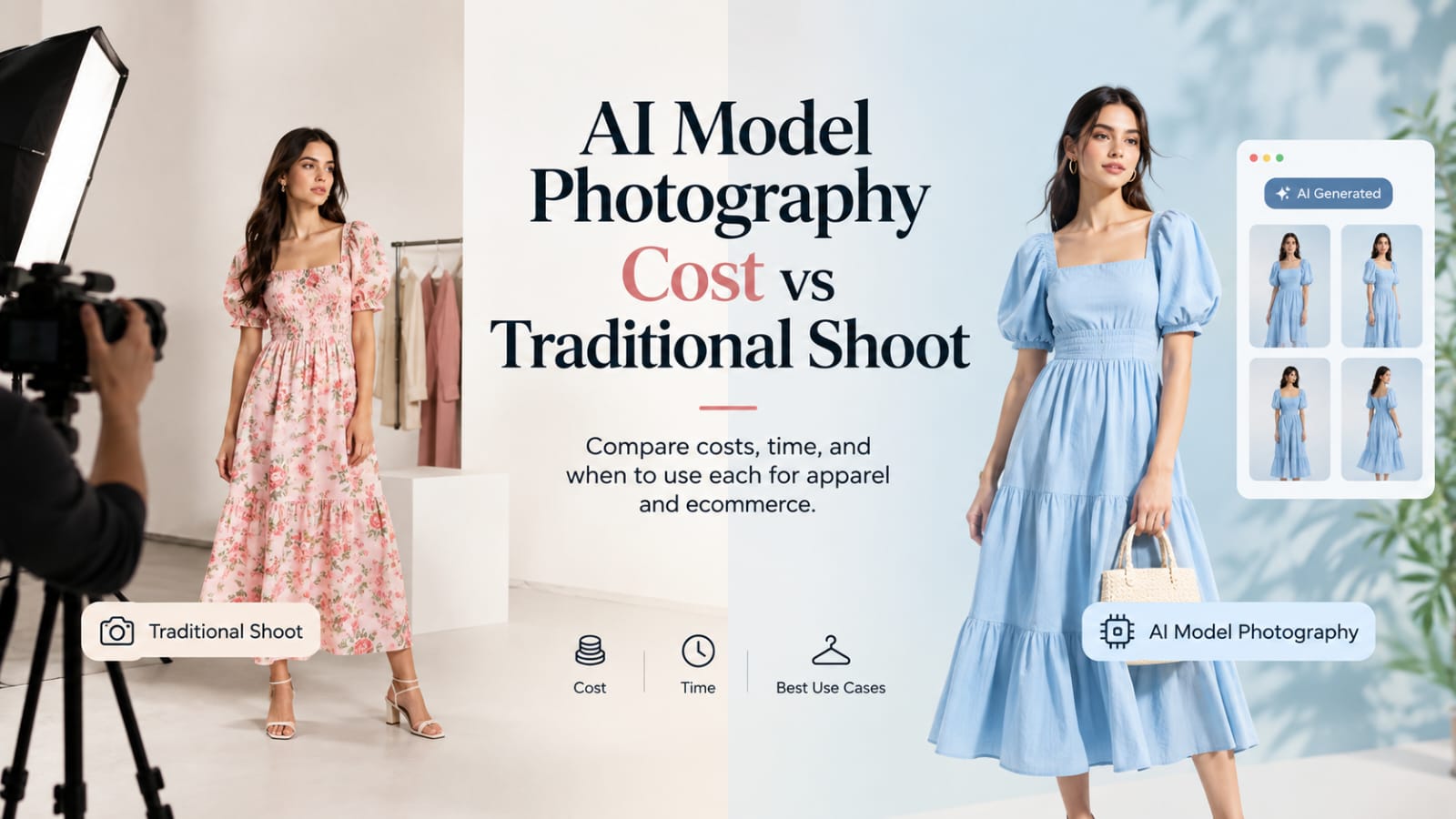
The question facing every apparel brand is the same: should we hire models and rent a studio for a photoshoot, or use AI to generate on-model imagery?
Both have costs. Both have trade-offs. Neither is universally better. The choice depends on your budget, timeline, product complexity, and how much control you need over the final image.
This guide breaks down what a traditional model shoot actually involves, what AI model photography costs in comparison, and when each approach makes sense for your brand.
What a Traditional Model Shoot Involves
A traditional product photoshoot with models requires more coordination than most brands realize.
Booking models. You need to hire models that fit your size range and brand aesthetic. Model agencies, freelance platforms, or direct hiring all have different costs. Professional models cost more than new talent. Diversity in casting adds cost.
Studio rental. A professional photography studio with adequate space, lighting infrastructure, and backdrops. Rental is hourly or daily. You pay whether you shoot four hours or eight.
Stylist and hair/makeup. Someone needs to style the garments, fix wrinkles between shots, and coordinate hair and makeup. Many shoots require dedicated stylists.
Photographer and assistants. A professional photographer and at least one lighting assistant. This is a full day commitment.
Props and set pieces. Depending on your shoot concept, you may need furniture, backgrounds, or other set pieces. These either need to be rented or sourced.
Clothing samples. You need multiple samples of each garment in different sizes for fitting and backup.
Retouching. After the shoot, images need color correction, skin retouching, background work, and sometimes compositing. Professional retouching takes time.
Timeline. A traditional shoot takes weeks to plan, one to three days to execute, and additional weeks for retouching. Total timeline is typically one to two months.
Cost breakdown. The total cost of a traditional shoot with models (including studio, models, stylists, photographer, assistants, retouching) generally runs high. A single shooting day can represent significant investment.
What AI Model Photography Costs
AI model photography has dramatically different cost and timeline.
AI tool subscription or per-image cost. Some platforms charge monthly subscriptions. Others charge per image generated. Costs are generally modest compared to a traditional shoot.
Photography (if needed). You still need product shots to feed into the AI. These can be simpler flat lays or on-mannequin shots, which are cheaper than styled on-model photography.
Retouching and refinement. AI-generated images often need human retouching to fix hands, fabric detail, logos, and accuracy issues. This adds cost but is typically less than a full retouching job.
Timeline. AI imagery can be generated in days. A simple product photo plus AI generation plus minor retouching can be done in one to two weeks, sometimes faster.
Cost comparison. AI model photography is generally significantly cheaper than a traditional shoot when you factor in all components. The cost per image is dramatically lower.
When AI Model Photography Makes Sense
AI is ideal for several scenarios:
Exploring multiple looks. You want to show your garment on different body types, in different colors, or in different environments without multiple shoots. AI can generate many variations quickly and affordably.
Quick turnarounds. You have a new collection drop and need images fast. AI is faster than booking models and renting a studio.
Budget constraints. Your budget doesn't accommodate a traditional shoot. AI lets you create on-model imagery affordably.
Many color variations. You have a product in five colors. Shooting each color separately is expensive. Generating each color with AI is affordable.
Secondary images. Your hero images are from a traditional shoot, but you need lifestyle or social images quickly. AI fills that need at lower cost.
Testing market. You're unsure if a product will sell. Creating on-model imagery with AI to test before investing in a traditional shoot is smart.
Unreleased products. You want to show upcoming products before they're manufactured. A traditional shoot is impossible. AI lets you show early concepts.
When Traditional Model Photography Still Wins
Traditional photography is still superior for certain situations:
Quality and realism. A real photograph of a real garment on a real person is always more realistic than AI-generated imagery. AI can look great, but it's not identical to reality.
Accuracy for key products. Your hero images need to match exactly what customers receive. Traditional photography guarantees accuracy. AI can hallucinate details or fabric texture.
Brand authenticity. Some brands build identity around real people wearing the product. AI doesn't provide that human connection.
Complex garments. Garments with intricate draping, multiple layers, or unusual details are harder for AI to render accurately. Traditional photography handles complexity better.
Inclusion and representation. If your brand prioritizes showing real people of different sizes, ages, and backgrounds, traditional photography with diverse models is more authentic than AI.
Product launches. Major launches deserve the investment in traditional photography. It signals importance and commitment to quality.
Customer trust. For some brands and customers, transparency about using real photography builds more trust than AI. Some customers explicitly prefer real people in product images.
AI Model Photography Cost Comparison
Here's how the approaches compare:
Traditional shoot: requires significant upfront investment in models, studio, stylists, photographer, and retouching. Timeline is weeks. Cost per final image is high.
AI model photography: requires modest upfront cost for AI tool and some product photography. Timeline is days. Cost per final image is low.
Hybrid approach: shoot a simple product photo or flat lay, use AI to generate on-model versions, then do light human retouching. Cost is moderate. Timeline is moderate. Quality is strong.
The Hybrid Approach
The smartest brands combine both approaches:
Shoot your product simply (flat lay or on-mannequin). This is cheap and quick.
Use AI to generate on-model versions in different sizes, colors, and environments.
Do light human retouching to fix AI flaws (hands, logos, fabric detail, garment accuracy).
Use the hybrid result for secondary images, social, ads, and product pages.
Keep one or two traditionally shot hero images for authenticity and brand credibility.
This approach gives you the speed and affordability of AI with the quality and accuracy of traditional photography.
AI Model Photography Cost Decision Checklist
- Do you need images fast or can you wait weeks?
- Is your budget limited or do you have significant investment?
- How many color variations do you need to show?
- How important is absolute accuracy to your customers?
- Do you need to show real people or is AI acceptable?
- Are your garments simple or complex with intricate draping?
- Do you need hero images or secondary images?
- What does your customer base expect to see?
FAQ
Q: Can I use AI-generated model images as my main product photos?
A: It depends on your brand and customer expectations. Some brands use AI exclusively. Others use it only for secondary images. Check your marketplace's current policies (they change). Be transparent about AI use if required. The key is accuracy: the garment in the AI image must match what ships.
Q: How much cheaper is AI than hiring models and renting a studio?
A: Generally significantly cheaper. A traditional shoot costs substantial investment in models, studio, stylists, photographer, and retouching. AI model photography costs a fraction of that. The exact difference depends on your shoot scope and AI platform choice.
Q: Do AI-generated images need retouching?
A: Usually, yes. AI often struggles with hands, text, logos, fabric texture, and garment accuracy. Light retouching by a human fixes these issues. This makes the hybrid approach (AI generation plus light retouching) practical and cost-effective.
Q: Should I abandon traditional photography in favor of AI?
A: Not necessarily. The best approach for most brands is hybrid: use traditional photography for hero images (authenticity and accuracy) and AI for secondary images, lifestyle shots, and social content (speed and cost). This gives you the best of both worlds.
AI model photography and traditional shoots each have merits. The choice depends on your timeline, budget, and brand values. Many successful brands use both, leveraging AI for speed and affordability while keeping traditional photography for authenticity and control. Explore AI-generated imagery with our AI generative model service and test on your own products to see what works for your brand.
%401x.svg)


