
 English
 Deutsch
How E-Commerce Brands Are Using AI to Create Lifestyle Product Images
June 5, 2026
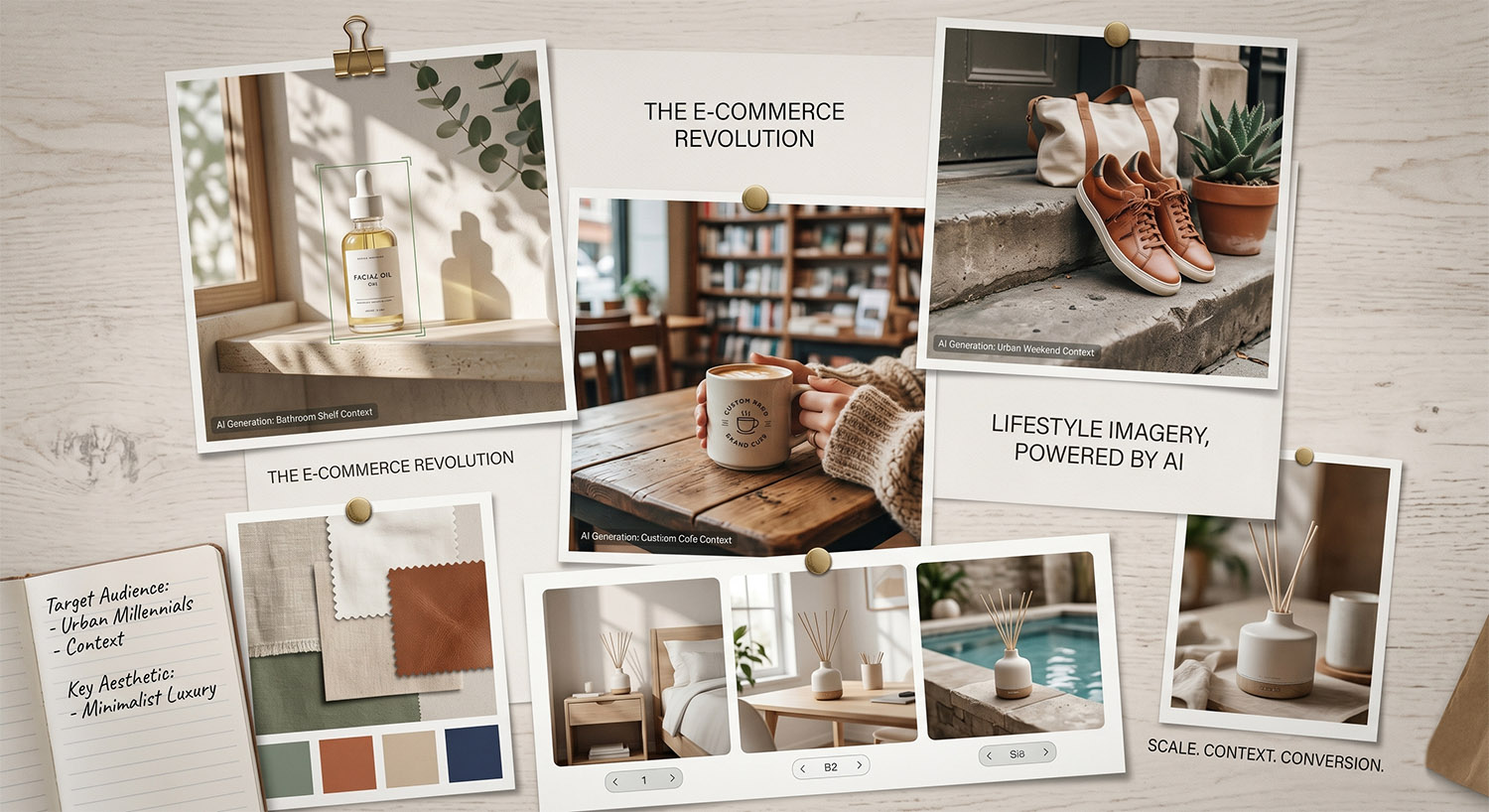
How E-Commerce Brands Are Using AI to Create Lifestyle Product Images
By HeroEdits | Post-Production Studio
There was a time when creating a beautiful lifestyle product image meant booking a location, hiring a stylist, coordinating a model, and spending an entire day on set — just for one scene. For large e-commerce brands, that process could cost thousands of dollars per image.
Today, the game is changing. AI is reshaping how brands produce lifestyle imagery — and the studios that understand both the power and the limits of this technology are the ones delivering the best results.
At HeroEdits, we work with premium product brands every day. Here is exactly how leading e-commerce brands are using AI to create lifestyle product images in 2025 — and what it actually takes to do it right.
What Is AI Lifestyle Product Photography?
AI lifestyle product photography is the process of using artificial intelligence tools to place a real product — or a model using a real product — into a digitally generated or composited lifestyle environment.
Instead of shooting a sofa inside an actual living room, you shoot the sofa in a studio and use AI to build the room around it. Instead of flying to a Scandinavian apartment for a baby brand shoot, you shoot the child on the product in a white studio and let AI construct the herringbone floors, the panelled walls, the warm window light.
The result, when done correctly, is indistinguishable from a real location shoot — at a fraction of the cost and time.
Why Brands Are Making the Switch
1. Speed
A traditional lifestyle shoot can take weeks to plan and days to execute. With AI compositing, the environment can be generated and refined in hours. For brands launching new collections or seasonal campaigns, this speed advantage is transformational.
2. Cost
Location fees, set design, travel, and styling add up fast. AI-generated environments eliminate most of these costs entirely. Brands can redirect that budget toward better models, higher retouching quality, or simply more images.
3. Consistency
When you shoot across multiple locations on different days, lighting and tone always vary slightly. With AI-built environments, every image in a collection can be graded and styled consistently — making the brand feel more cohesive across its entire visual library.
4. Scale
A brand launching 60 product variations cannot afford 60 separate lifestyle shoots. AI makes it possible to produce a full image library at scale without exponentially scaling the production budget.
How the Workflow Actually Works
This is where most articles get vague. At HeroEdits, our AI compositing workflow follows a precise sequence — because skipping steps is how you end up with images that look fake.
Step 1 — Studio Photography First
The product and the model are always photographed in a controlled studio environment. Clean lighting. White or neutral backdrop. Multiple angles. This gives us a pixel-perfect, well-lit subject to work with.
Critical rule: The hero product is never AI-generated. If a client's play mat has a specific pattern, color, and texture — that mat must be photographed in the studio. AI cannot replicate a specific product with 100% accuracy. It interprets. It approximates. For premium brands, approximation is not acceptable.
Step 2 — Environment Generation
Once the studio images are approved, we generate the lifestyle environment separately — an empty room with no people in it. This gives us full control over composition, lighting direction, and atmosphere before we commit to placing the subjects.
We specify everything: the floor material, the wall finish, the furniture, the props, the art prints, the light source direction. The room is generated, reviewed, and refined until it matches the brand's vision exactly.
Step 3 — Compositing
The studio cutout — model, product, and all — is placed into the generated environment. Shadows are added. Edges are blended. The camera perspective is matched. At this stage, the image starts to look like it was shot in a real room.
Step 4 — Human Retouching
This is the step that most AI-only workflows skip — and it is the step that makes the difference between an image that looks generated and one that looks real.
Our retouchers handle edge blending, shadow naturalisation, color grading, and any inconsistencies the AI introduced. The final image is polished by hand. This human layer is what makes the work premium.
What AI Is Good At — And What It Is Not
Being honest about this is important. Brands sometimes come to us expecting AI to be a magic button. It is a powerful tool, but it has real limitations.
AI is excellent at:
- Building room environments and interior scenes
- Matching lighting mood and atmosphere
- Generating props, furniture, and background elements
- Producing consistent color grading and film aesthetics
AI struggles with:
- Replicating a specific product's exact pattern, texture, or color
- Maintaining precise geometric details (tile seams, print patterns, embossed logos)
- Producing photorealistic human skin at high resolution without retouching
- Getting proportions and perspective perfectly right without human correction
The brands getting the best results from AI are not the ones trying to replace their photographers. They are the ones using AI to replace location shoots and set builds — while keeping their studio photography and human retouching in place.
Real-World Example: Baby and Kids Brands
One of the fastest-growing use cases for AI lifestyle compositing is baby and children's product brands. Here is why:
- They need large image libraries for different SKUs and colorways
- Their products are used in home environments that are expensive to replicate on set
- Their target audience responds strongly to warm, aspirational editorial imagery
- Consistency across a catalog is critical for brand perception
A typical workflow for a baby brand looks like this:
Photographer shoots children on products in studio → HeroEdits generates premium home interiors around them → Retouchers blend and color grade → Final images delivered via VolleyDrive for client review and approval
What used to require three days of location shooting and set dressing can now be delivered as a full library of 60 cohesive lifestyle images — in less time and at a significantly lower cost.
The Honest Truth About AI and Product Imagery
AI is not replacing photographers, retouchers, or post-production studios. It is replacing the parts of production that were always logistical and expensive — the location, the set, the props — while keeping the parts that matter most: the real product, the real model, and the human eye that knows when something looks right.
The brands winning with AI lifestyle imagery right now are the ones who understand this distinction. They invest in great studio photography and great retouching — and they use AI to build the world around those assets.
At HeroEdits, that is exactly how we work.
Ready to Explore AI Lifestyle Photography for Your Brand?
If you are a product brand looking to scale your visual content without scaling your production budget, we would love to show you what is possible.
HeroEdits is a premium post-production studio specialising in image retouching, compositing, and AI-assisted lifestyle photography for e-commerce brands. Our work is delivered and proofed through VolleyDrive, our purpose-built image delivery platform.
%401x.svg)


