
 English
 Deutsch
AI Product Photography vs Traditional: When to Use Each
July 28, 2026
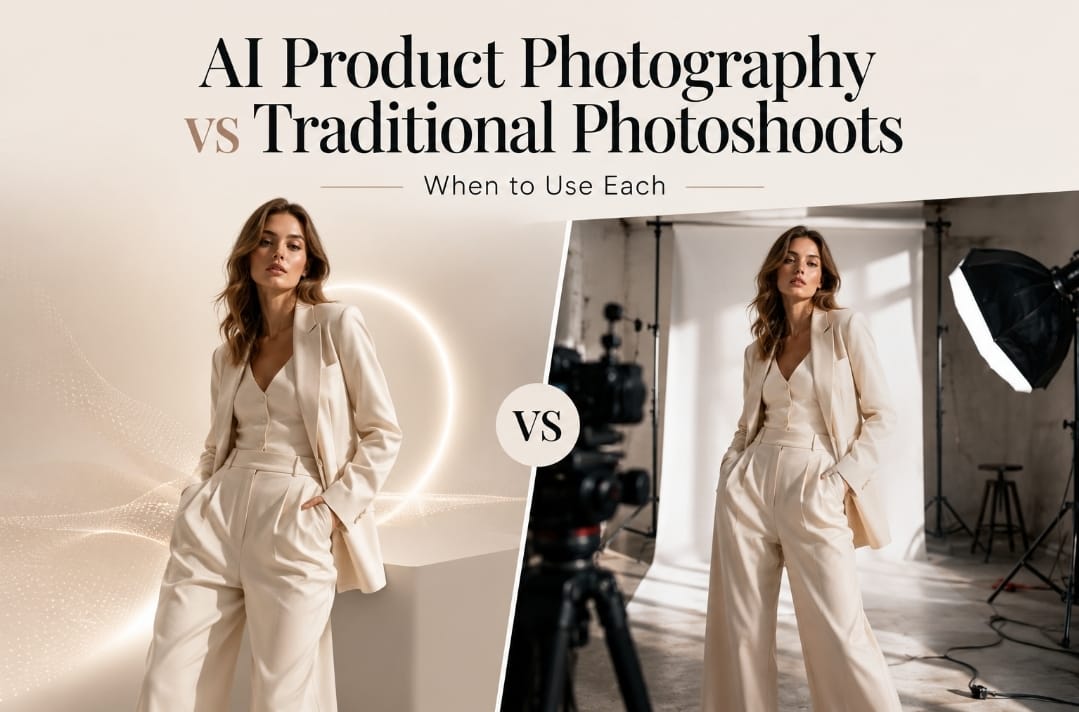
The debate is real. Should you invest in traditional product photography, or use AI to generate product images?
Both have their place. Neither is a complete replacement for the other. The choice depends on your product type, budget, timeline, and brand standards.
This guide compares AI product photography and traditional photoshoots across cost, quality, speed, and use cases. By the end, you'll know which approach fits your business.
What Is AI Product Photography
AI product photography uses generative models to create photorealistic product images from text descriptions or reference photos. You describe what you want and the AI generates variations. Some tools can also extend existing photos, change backgrounds, or create lifestyle scenes.
The technology has improved significantly in recent years. AI can now produce realistic-looking products quickly and affordably.
AI product photography is fast, cheap, and flexible. It's also imperfect. Images sometimes show unrealistic product details, unusual artifacts, or proportions that don't match reality. Disclosure requirements may apply depending on your jurisdiction and platform.
What Is Traditional Product Photography
Traditional product photography means hiring a photographer, securing a space (studio or location), setting up lighting, and capturing real product images.
The photographer uses professional equipment, lighting setup, and composition skills to create clean, realistic images. Post-processing (editing, color correction, retouching) follows. It's time-consuming, expensive, and labor-intensive.
But it's real. The product is actually photographed, so the image matches reality. Lighting is controllable. Composition is intentional. Quality is consistent.
Cost Comparison: AI Product Photography vs Traditional
AI product photography. Cost per image is minimal to very low. Setup is essentially free. Revisions are quick and inexpensive. You can generate many variations with one description.
Traditional product photography. Cost per image varies widely depending on photographer skill, location, and complexity. Setup costs are significant. Revisions are expensive because re-shooting requires booking time again.
Winner: AI is dramatically cheaper upfront.
However, AI images often need post-processing too. And if they're not good enough, you'll need to re-generate or hire a designer to fix them. The seemingly free option sometimes costs more in labor than paying a photographer upfront.
Speed Comparison: AI Product Photography vs Traditional
AI product photography. Time to first image is minutes. Write a description, generate image.
Time to approved batch is hours to a day. Generate, review, pick the best options.
Iteration is instant. Change your description and re-generate immediately.
Traditional product photography. Time to first image is weeks. Schedule a photographer, prepare products, shoot, edit, deliver.
Time to approved batch is two to four weeks minimum.
Iteration is slow. Re-shooting means another booking, cost, and wait.
Winner: AI is vastly faster.
For seasonal campaigns or quick turnarounds, AI is unbeatable. For a brand shoot that needs to be perfect, traditional is more reliable.
Quality Comparison: AI Product Photography vs Traditional
AI product photography. Realism is improving steadily, but still imperfect. Hands often look unusual. Fine details may be fabricated or distorted. Logos and text are frequently incorrect or illegible.
Consistency is hard to control. Two generations of the same description might look noticeably different.
Brand control is limited. The AI interprets your description. You don't control every detail.
Editability is easy. Change the background, adjust colors, try new variations.
Authenticity is minimal. It's generated, not photographed.
Traditional product photography. Realism is perfect. It's a real product, really photographed.
Consistency is high. A professional photographer and editor ensure continuity across a shoot.
Brand control is complete. You direct the shoot, approve angles, lighting, and styling.
Editability takes time. Retouching or reshooting is expensive.
Authenticity is complete. You can use images in ads with full confidence.
Winner: Traditional is superior for quality and authenticity. AI is flexible for speed.
When to Use AI Product Photography
Lifestyle mockups and lifestyle scenes. AI excels at placing a product in a context (beach, office, living room, nightclub). If you need variations of one product in different settings, AI is efficient.
Exploration and brainstorming. Before committing to a traditional shoot, use AI to explore ideas. "What would this product look like in a minimalist kitchen?" AI can show options in minutes.
Filling inventory gaps. You have many products photographed and a few that aren't. AI can generate placeholder images while you schedule a shoot for the rest.
On-demand customization. If you sell customizable products (printed items, engraved products), AI can show customers variations with their custom content applied.
Social media and ads. For small-budget campaigns, AI images are fast and cost-effective. Many platforms now disclose AI-generated content, but it's still acceptable for ads if clearly labeled.
Speed-sensitive timelines. Launching in two weeks? AI can give you something fast while you source higher-quality images for later.
When to Use Traditional Product Photography
Core product listings. Your main ecommerce images should be traditional. Customers expect to see a real product, lit well, from the right angle. AI-generated images look good initially but often disappoint when details don't match reality.
Brand-critical launches. A major product release deserves professional photography. The cost is worth the credibility and visual consistency.
On-model or lifestyle photography. AI can't match a real model wearing your product, styled on a real set, under professional lighting. The human element matters for fashion, beauty, and apparel.
High-price-point products. A luxury handbag or high-end watch deserves real photography. Customers scrutinize details carefully. AI can't be trusted at this level.
Compliance and authenticity. Some platforms require real product photography. Transparency and authenticity are non-negotiable.
Consistency across a catalog. If you're building a cohesive visual brand across many products, traditional photography ensures every image follows the same lighting, style, and quality standard. AI variations are hard to control at scale.
The Hybrid Approach: Using Both
Smart brands use both approaches together.
First, shoot core product images traditionally. Get your main catalog photographed by a professional.
Second, use AI for variations and lifestyle. Place the product in different settings, show alternative angles, or create mockups with AI.
Third, use AI to fill gaps quickly. While waiting for a full shoot, generate lifestyle scenes to show the product in context.
Fourth, test ideas before committing. Use AI to explore styling, background, or composition before booking a photographer.
This hybrid approach gives you speed and efficiency without sacrificing core quality.
AI Product Photography Workflow Checklist
- Define what you need (lifestyle, mockups, variations, placeholders)
- Select an AI tool that fits your needs
- Write clear, detailed descriptions for each image
- Generate multiple variations
- Review quality and accuracy
- Edit or refine as needed
- Disclose AI generation if required by platform
- Combine with traditional images for main listings
- A/B test AI vs traditional images
- Measure performance and ROI
FAQ
Q: Can I use AI-generated product images on my ecommerce store?
A: Legally, yes, but check your platform's requirements. Amazon, Etsy, and others increasingly require real product photography or disclosure of AI generation. If you use AI images, transparency is advised and often required.
Q: Will customers notice if my product image is AI-generated?
A: Possibly. AI has improved, but artifacts and unrealistic details still appear. For fashion and beauty, discerning customers will spot inconsistencies. For simple products on lifestyle mockups, AI is harder to detect.
Q: Can I combine AI and traditional photography?
A: Absolutely. This is the smartest approach. Use traditional photography for your main listing images, then AI for lifestyle mockups, alternative backgrounds, or fill-in shots.
Q: What's the best way to start with AI product photography?
A: Experiment with free or low-cost AI tools first. Test on a small number of products. Compare results to traditional photos. Measure customer response. Then decide whether to scale AI or stick with traditional.
The best choice depends on your budget, timeline, and brand standards. For core product images that drive conversions, traditional photography is still the gold standard. For lifestyle variations, mockups, and quick turnarounds, AI is unbeatable. Many successful brands invest in professional traditional photography for their main catalog and use our AI generative model to complement it with lifestyle variations and mockups. Test your vision with a free test batch to see what works best for your brand.
%401x.svg)


