
 English
 Deutsch
CGI vs Photography for Product Images: Which to Choose
October 30, 2026
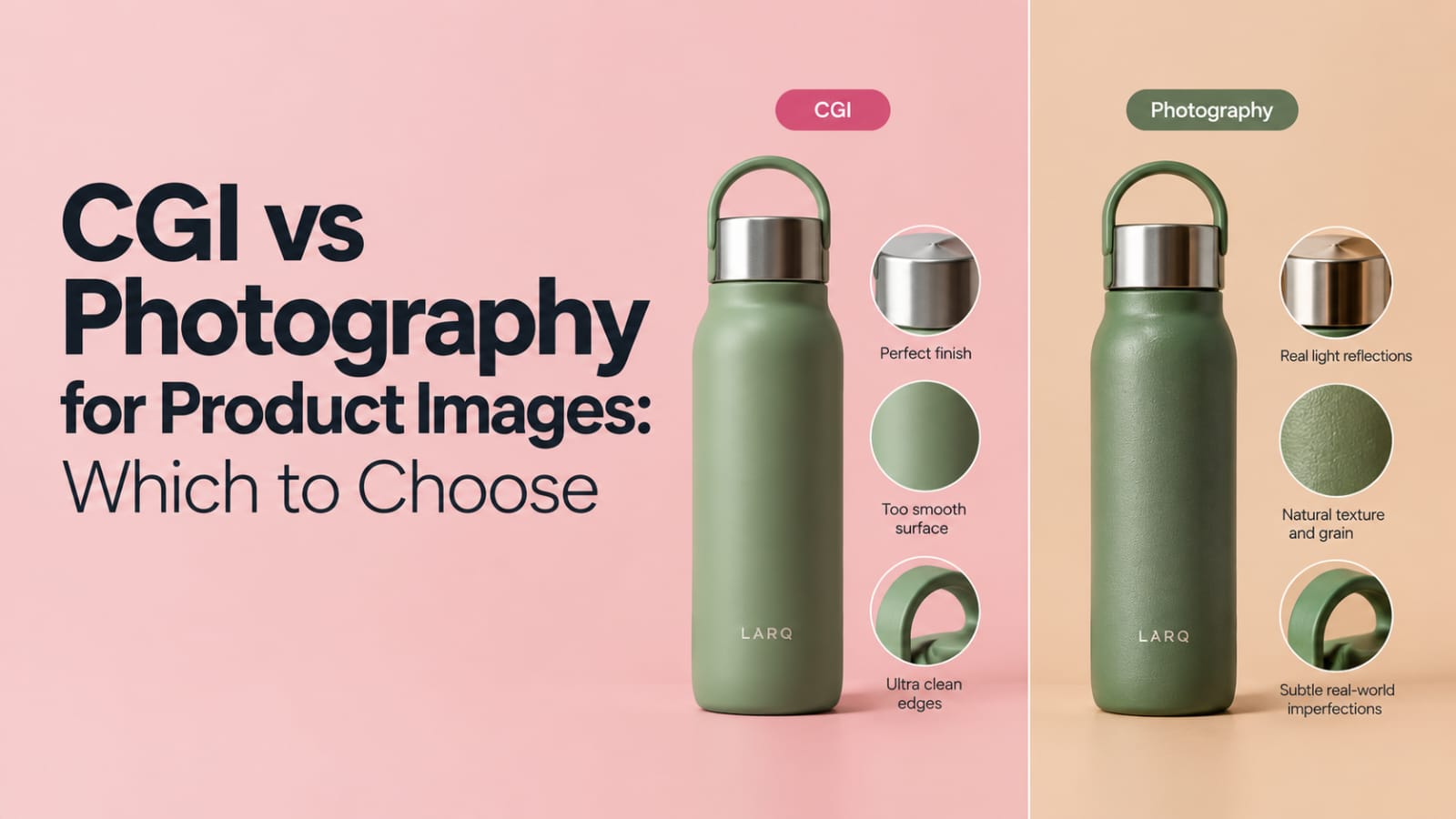
Every brand selling physical products eventually faces the same decision. Do you invest in a traditional photoshoot, or do you build your product visuals with 3D rendering? Both can produce images that look convincing. Both have real strengths and real limits.
The right answer depends on what you're selling, how many variations you need, and how much the image needs to prove about the physical item. Neither method is automatically better. The question is which one fits your product and your timeline.
This guide compares CGI product rendering and photography across the situations where each one wins, the trade-offs to weigh, and how to decide for your brand.
What CGI Product Rendering Involves
CGI product rendering, sometimes called 3D product visualization, builds a digital model of a product and renders it as a photorealistic image. The process typically includes modeling the product in 3D, applying materials and textures, setting up virtual lighting, and rendering the final image.
A 3D model can be created from technical drawings, CAD files, or a physical sample that is scanned or measured. Once the model exists, it can be placed in any environment, shown from any angle, and recolored without a new physical shoot.
Rendering requires specialized skills. Modeling, material setup, lighting, and compositing are different disciplines. Quality depends heavily on the artist's experience and the accuracy of the source information.
What Traditional Product Photography Involves
Traditional product photography captures a physical item with a camera under real lighting. The product must exist, be available for the shoot, and be prepared for the camera.
The process includes setting up the studio, lighting the product, styling and positioning it, shooting, and then retouching the results. Each variation, such as a new color or a new angle, typically means returning to the set.
Photography captures real surface behavior, including the way light falls on fabric, the subtle imperfections of materials, and the true scale of the object. That authenticity is hard to replicate exactly.
When CGI Beats a Photoshoot
CGI has clear advantages in several situations.
Unreleased products. If the product is still in development or not yet manufactured, a 3D model can show it to customers, press, or retailers before production begins. Photography is impossible without a physical sample.
Many variants. A product offered in dozens of colors, finishes, or configurations can be rendered efficiently by changing materials in the model. Shooting every variant physically is slow and expensive.
Furniture and large items. Sofas, cabinets, and large fixtures are difficult to move, store, and light in a studio. Rendering can place them in rooms, show them from every angle, and keep the scene consistent.
Packaging and mockups. Boxes, bottles, and packaging designs can be rendered with the artwork applied, allowing quick iterations before printing.
Exploded views and internal details. CGI can show how components fit together or reveal internal structure without damaging a physical product.
Consistency across a range. When a line of products shares the same lighting setup, camera position, and environment, CGI can enforce that consistency precisely.
Reduced logistics. There is no need to ship samples, schedule talent, or coordinate a shoot day. Revisions can be made digitally.
When Real Photography Still Wins
Photography remains the stronger choice in other situations.
Fabric and soft materials. Textiles, knitwear, and leather have subtle behaviors that are hard to model perfectly. Drape, wrinkles, and fiber detail often look more convincing in a real photograph.
Products customers scrutinize closely. Jewelry, cosmetics, and food are judged on texture, sheen, and color. Real photography shows exactly what the customer will receive.
Fashion and on-body fit. Showing how a garment moves and fits a body is still most credible with real people or accurate mannequin photography.
Brand authenticity. Some brands build trust by showing real products made by real people. A rendered image may feel distant to that audience.
Products that already exist. If you have physical stock and a clear shoot plan, photography is often faster and more economical than building a model from scratch.
Accuracy when stakes are high. For hero images on items where an error would lead to returns or disputes, a verified photograph provides a clear reference.
Honest Trade-Offs
Neither approach is free of compromise.
Upfront cost. CGI often requires a significant initial investment to build accurate models, especially for complex products. The per-image cost drops as more renders are created from the same model, but the setup is substantial.
Photography costs scale with each shoot, variant, and location. Adding a new color often means a new session.
Realism. Strong CGI can be indistinguishable from photography at normal viewing sizes, but close inspection can reveal artificial edges, lighting, or material behavior. Photography captures reality directly, so it does not carry this risk.
Accuracy. A 3D model is only as accurate as the data behind it. If the source measurements or material references are wrong, the render will be wrong too. A photograph shows the physical product as it is.
Speed. Once a model is ready, CGI can produce variations quickly. Initial model creation can take time. Photography can be quick for a single product on an existing setup but slower for large catalogs requiring many sessions.
Flexibility. CGI makes changes easy, such as moving a product into a new scene or changing a color. Photography offers spontaneity and the chance to capture unexpected, natural moments.
How to Decide for Your Brand
Start by asking what the image needs to prove. If the image must show the real item exactly, photography is usually the safer choice. If the image needs to show a concept, a variant, or an environment, CGI may be the better fit.
Consider your product count and variation level. A small catalog with few variants may favor photography. A large range with many colors or configurations may favor CGI.
Look at timing. If the product is not yet available, CGI may be the only option for early visuals.
Think about the material. Soft goods and high-touch products usually benefit from photography. Hard surfaces, furniture, and packaging are often strong candidates for rendering.
Many brands use both. They photograph hero images and core product details, then use CGI for color variants, room scenes, packaging mockups, and pre-launch visuals. This split keeps accuracy where it matters most and efficiency where it helps.
CGI vs Photography Decision Checklist
- Does the product exist physically and is it available for a shoot?
- Does the image need to show exact surface texture and material behavior?
- How many colors, sizes, or configurations need visuals?
- Is the product large, fragile, or difficult to move?
- Is the product unreleased or still in development?
- Would an error in the image likely lead to returns or disputes?
- Is accurate source data (CAD files, measurements, material references) available?
- Does your brand rely on real people or authentic product presentation?
- What is your timeline for launch or catalog updates?
- Does your budget favor upfront investment or per-shoot spending?
FAQ
Q: Can CGI product images be used on marketplaces and ecommerce stores?
A: Many brands use rendered images on their own sites and in marketing. Marketplace rules on synthetic or rendered imagery vary and change over time, so check each platform's current image policy before listing. Some platforms also expect the main image to show the real product.
Q: How accurate does a 3D model need to be?
A: It needs to be accurate in the details that matter to the buyer. Dimensions, proportions, material finish, color, and visible hardware should match the physical product. Accuracy depends on the quality of the source data, so measurements and reference samples are important.
Q: Is CGI cheaper than photography?
A: It depends on the product and the volume. CGI usually has a higher setup cost but lower cost per variant once the model exists. Photography is often more economical for a small number of existing products. Requesting quotes for your specific catalog is the best way to compare.
Q: Can I combine CGI and photography?
A: Yes, and many brands do. Photography can anchor the hero images and fabric detail, while CGI handles color variants, room scenes, and packaging mockups. Keeping a clear reference to the physical product helps the two stay consistent.
CGI and photography both have a place in product visual strategy. CGI excels when products are unreleased, highly variable, large, or difficult to shoot. Photography remains the strongest choice for materials, fit, and images where the customer must see the real item. Most brands benefit from matching each product to the method that best serves its accuracy and efficiency needs. If you want to test how 3D visuals fit your range, explore our 3D CGI service and send a few products for a test batch.


