
 English
 Deutsch
The Realism Test: What Makes an AI-Generated Model Shot Actually Believable
July 3, 2026
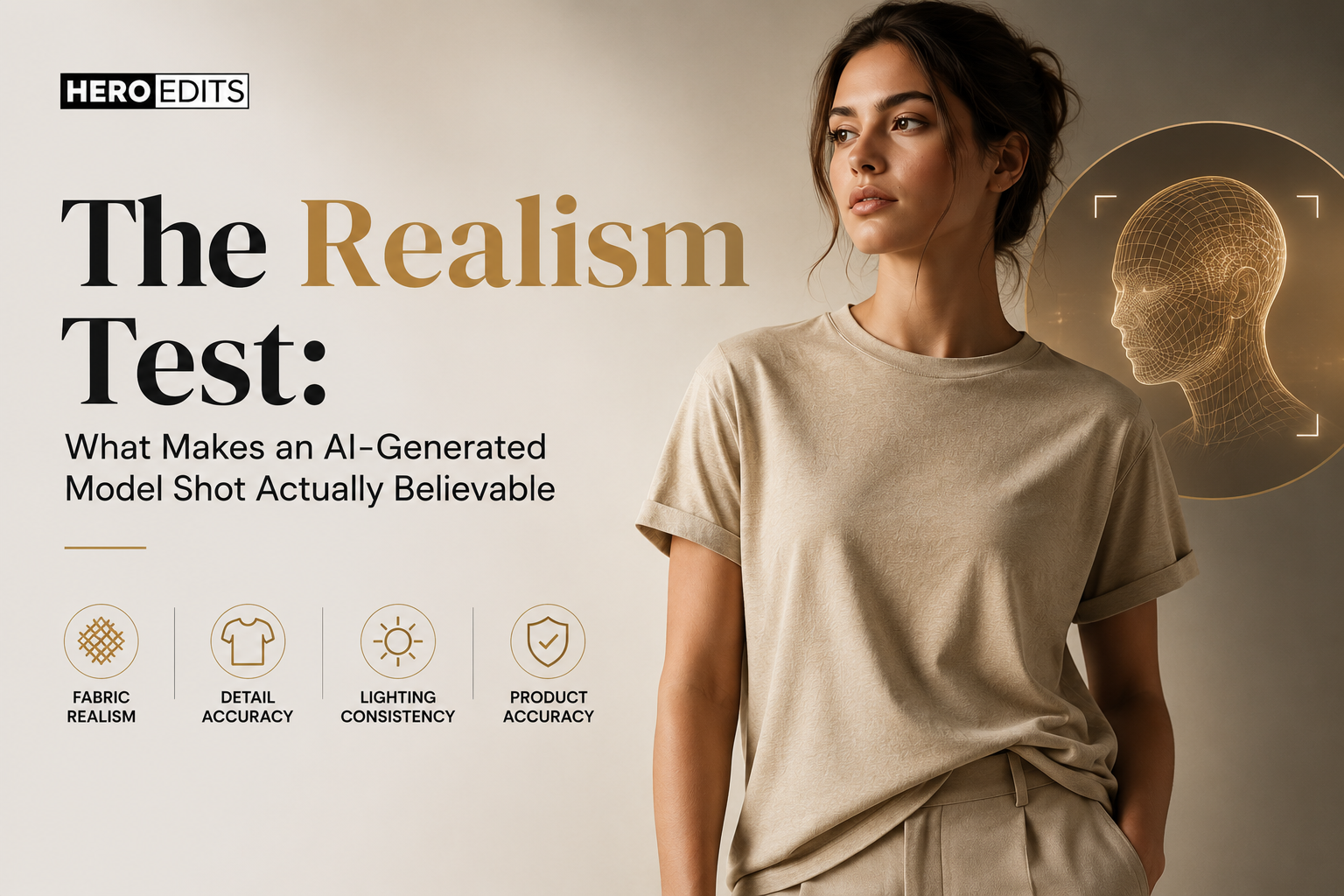
The Realism Test: What Makes an AI-Generated Model Shot Actually Believable
AI-generated model imagery has gotten good enough that brands are genuinely using it -not as a novelty, but as a real part of the catalog. But "good enough to try" and "good enough to publish" are two different bars. The gap between them almost always comes down to a handful of specific details that either sell the illusion or break it.
If you've ever looked at an AI-generated product-to-model image and felt something was slightly off without being able to say what, it was probably one of these.
Why This Gap Matters More Than It Seems
It's tempting to treat small imperfections in a generated image as a minor polish issue -something to fix later if there's time. In practice, they carry more weight than that. A customer doesn't consciously catalog what's wrong with an image; they just feel a flicker of doubt and move on to the next brand. Over a catalog of hundreds of items, that flicker adds up to lost conversions and, worse, returns from customers who received something that didn't match what the photo implied.
This is why realism isn't a cosmetic standard. It's directly tied to whether the image is doing its actual job: representing the product accurately enough that someone can decide to buy it with confidence.
1. Fabric Has to Behave Like Fabric
This is the biggest tell. Real fabric drapes, folds, and stretches based on the body underneath it and the material it's made of -cotton behaves differently from silk, which behaves differently from denim. Early or lower-effort AI generations tend to paint fabric that looks smooth and correct from a distance but doesn't actually respond to the pose. A sleeve that should crease at the elbow stays suspiciously flat. A dress that should pull slightly at the hip sits like it's floating.
Different fabric categories fail in different ways, too. Knits tend to lose their natural stretch and cling; the generated version looks stiffer than the real thing. Structured tailoring -blazers, coats, often loses the crisp edge at seams and collars that gives tailored pieces their shape. Denim can end up too smooth, missing the characteristic creasing at the knees and hips that even a fresh pair would show on a moving body.
Getting this right takes a retoucher checking the garment against how that specific fabric actually moves -not just approving whatever the model output first, and not applying one generic standard of "realistic" across every material.
2. Hands, Seams, and Small Details Give It Away Fast
Hands remain one of the hardest things for any generative model to get consistently right, and they're exactly where a viewer's eye tends to land. The same is true for stitching lines, buttons, zippers, and logo placement -small, structured details that a real garment has and that generated imagery can subtly warp or blur.
A common pattern: the overall silhouette of the garment looks correct, but a closer look shows a button that doesn't quite align with its buttonhole, or a logo that's slightly stretched or positioned a few degrees off from where it sits on the real product. These are exactly the details a customer zooms in on before buying, which makes them a poor place to leave uncorrected.
A believable image needs someone checking these specific spots, not just reviewing the shot as a whole.
3. Lighting Has to Match the Product's Real Behavior
If the base product photo was shot with a particular sheen, texture, or reflectivity, the generated model image needs to preserve that. A satin fabric that loses its reflective highlight, or a matte cotton piece that suddenly looks glossy, is an accuracy problem as much as an aesthetic one. It risks setting the wrong expectation for what's arriving in the box.
This also extends to how light falls across the whole scene. If a brand's imagery has an established lighting style — soft and even for a minimalist catalog, more directional and moody for a premium line -a generated shot that doesn't match breaks visual consistency across the site, even if the individual image looks fine on its own.
4. The Product Still Has to Be the Same Product
The most important standard isn't how good the model looks, it's whether the garment in the generated image is still recognizably, accurately the item being sold. Color has to hold. Proportions have to hold. Pattern placement has to hold. It's easy to generate a striking image and lose track of whether it's still representing the actual product faithfully.
This is where a side-by-side check against the original reference photography earns its place in the workflow. Not a glance, but an actual comparison: does the collar sit the same way, does the pattern repeat correctly across a seam, is the color reading the same under this new lighting as it did in the flat-lay or ghost mannequin shot it was generated from.
What a Proper Review Process Looks Like
A generated image that's ready to publish has usually passed through a few concrete checks, not just a general impression of "looks good":
- Fabric behavior matched against how that material moves in real reference shots
- Hands, seams, and hardware checked at full zoom, not just thumbnail size
- Lighting and sheen compared against the base product photo
- Color and proportion verified against the original garment, not just the generated output
- Consistency across the set, if multiple angles or poses are being generated for the same product
Skipping any one of these doesn't always produce an obviously broken image, it often produces one that looks fine at a glance and slightly wrong on a second look, which is the exact impression that erodes trust without the customer being able to say why.
Where This Leaves Brands
AI-assisted imagery is a genuinely useful tool for scaling a catalog without a full reshoot for every angle or every size but it isn't a set-and-forget process. The realistic results come from treating the output as a first pass that a retoucher then checks and corrects, the same way a raw photograph gets checked before it goes live.
At HeroEdits, AI-assisted imagery goes through that same review: fabric behavior, small details, lighting consistency, and product accuracy, checked by a person before it's approved because the goal was never to look AI-generated. It was to look right.
Exploring AI-assisted imagery for your catalog? Talk to HeroEdits about what it would look like for your products.
%401x.svg)


