
 English
 Deutsch
Jewelry Photo Retouching: Hardest E-commerce Edit
September 18, 2026
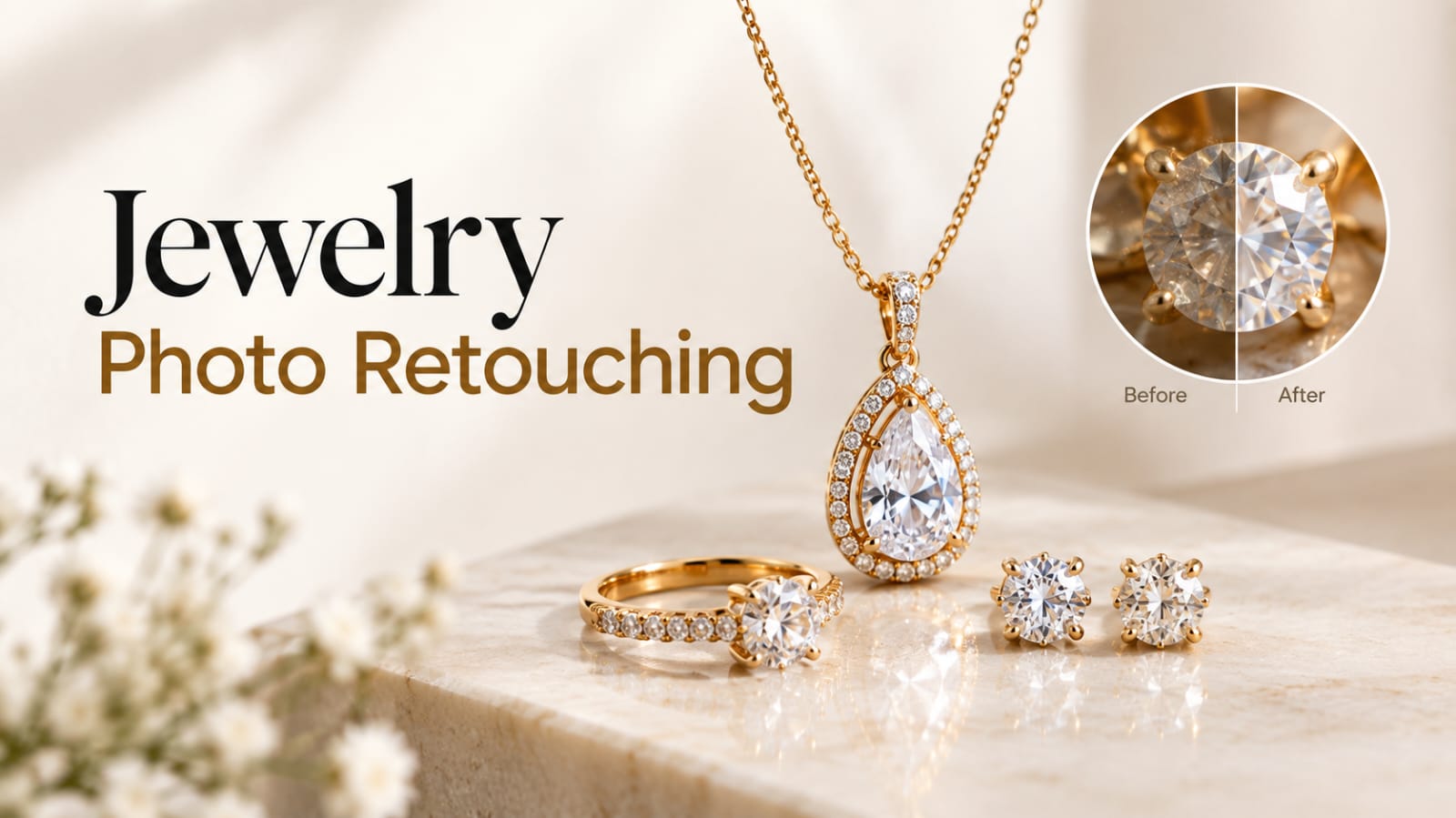
Jewelry photo retouching is unforgiving. Every imperfection shows. Dust particles the size of a grain of sand become visible at 100% zoom. Fingerprints on a diamond catch light in unnatural ways. The photographer's reflection in polished metal stares back at you from the image.
Macro photography, which is essential for jewelry, exposes everything. This is why jewelry photo retouching is considered among the hardest editing tasks in ecommerce. It's not glamorous work. It's meticulous, demanding, and requires both technical skill and artistic judgment.
This guide covers what makes jewelry photo retouching so challenging, what professional jewelry retouching includes, metal recoloring across a shoot, and how to judge quality when you're examining images at full zoom.
Why Jewelry Photo Retouching Is So Difficult
Macro photography shows extreme detail. A standard product photo at normal distance hides imperfections. Macro photography for jewelry magnifies everything. Dust, fingerprints, scratches, and reflections that would be invisible at normal magnification become glaring at 100% zoom.
Surface imperfections are everywhere. Jewelry is metal, stone, and sometimes enamel or other materials. Each surface catches light differently and shows imperfections differently. A tiny dust particle on a diamond looks like a blob. A fingerprint on gold looks like a smudge.
Reflections are a nightmare. Polished metal reflects everything. The studio lights. The photographer. The camera. The person holding the jewelry. All of these reflections need to be removed or corrected. Removing reflections while maintaining the natural shine of the metal is an advanced skill.
Color accuracy is critical. A gold ring that looks too yellow or too orange in a photo will be returned. A diamond that looks too blue or too cloudy loses appeal. Color grading jewelry requires understanding how different metals and stones should appear in natural light.
Lighting creates unnatural highlights. Macro photography lighting often creates harsh highlights on jewelry. These need to be softened and blended to look natural. A sharp, unnatural highlight ruins the image.
Consistency across a jewelry line is essential. A customer browsing a jewelry collection expects all images to have the same lighting, the same color grading, the same level of shine. Inconsistency across pieces makes the collection look disjointed.
What Macro Photography Exposes in Jewelry Photo Retouching
When you shoot jewelry at macro magnification, you see things that are invisible at normal distance.
Dust and particles. A single dust particle that would be invisible on a standard product photo becomes a visible speck at macro. Studio dust, lint from the photography surface, even air particles all become visible.
Fingerprints and skin oils. Anyone who touches jewelry during setup leaves fingerprints and oils on the surface. At macro magnification, these are clearly visible and look unprofessional.
Surface scratches and wear. Even brand new jewelry sometimes has microscopic scratches from manufacturing or handling. Macro photography shows these. They need to be minimized or removed.
Unnatural reflections. The studio lights, camera, photographer, and surrounding environment all reflect in polished metal. These reflections need to be removed or minimized.
Imperfect edges and joins. Where metal joins (stone settings, prongs, clasps) are often imperfect at the macro level. These need refinement.
Color inconsistency. Different angles and lighting reveal color inconsistency. A gold ring might look slightly different yellow or orange depending on angle. This needs to be evened out.
Stone flaws and cloudiness. Diamonds, gems, and other stones sometimes have internal flaws, cloudiness, or inclusions. At macro magnification, these become visible. Some can be minimized through retouching. Others can't be fixed and are part of the stone's natural characteristic.
What Professional Jewelry Retouching Includes
Professional jewelry retouching addresses all of these challenges.
Dust and particle removal. Using healing tools and content-aware fill, dust particles are removed. This is tedious work that requires care not to damage the surrounding surface.
Fingerprint and oil removal. Fingerprints are carefully removed while preserving the natural texture and finish of the metal.
Surface refinement. Microscopic scratches are minimized. Surface texture is preserved while removing obvious damage.
Reflection removal or reduction. Distracting reflections of the photographer, camera, or studio are removed or minimized. The goal is a clean, distraction-free image where the jewelry is the focus.
Highlight softening. Harsh macro photography highlights are softened to look more natural. The jewelry still has shine and dimension, but it looks natural rather than over-lit.
Color correction and grading. Gold, silver, rose gold, and other metals all have specific color targets. Professional retouching ensures the metal looks natural and matches the actual color. Stones are color-graded to look natural and appealing.
Metal recoloring (if needed). If a jewelry shoot has lighting inconsistencies across pieces, some items might need slight metal recoloring to match the others. A skilled retoucher can adjust the warmth or saturation of metal to create consistency.
Stone enhancement (subtle). Sometimes a diamond or gemstone looks slightly cloudy or dull due to lighting. Subtle enhancement can brighten it and make it more appealing. This is done carefully to not look artificial.
Background consistency. If the background needs adjustment (white background refinement, shadow adjustment, etc.), professional jewelry retouching handles this.
Metal Recoloring Across a Jewelry Shoot
One of the hardest tasks in jewelry retouching is metal recoloring when a single shoot has inconsistent lighting.
If you shot 50 gold rings and 20 of them look slightly more yellow while 30 look slightly more orange, you have an inconsistency problem. A professional retoucher can selectively adjust the color temperature of the metal on individual pieces to bring them all into alignment.
This is not changing the actual metal color. It's correcting the appearance to match how the metal should actually look in natural light.
Metal recoloring requires understanding color temperature, hue, and saturation. A skilled retoucher knows how gold should look at different angles and lighting and can adjust to create consistency without making it look artificial.
This level of work is advanced. Not all retouchers can do it well. It's one of the reasons jewelry retouching commands higher rates and longer timelines than standard product retouching.
How to Judge Jewelry Retouching Quality
Never judge jewelry retouching on small thumbnails. Always examine images at full zoom (100% or larger).
Look at the metal surface. Is it smooth and natural-looking? Or does it have artifacts, halos, or obvious editing marks? Quality retouching should be invisible.
Look at reflections. Are there obvious reflections of the photographer or camera? Or has the metal been cleaned of distracting reflections while retaining natural shine?
Look at edges. Are stone settings and prongs clean and sharp? Or are they fuzzy or poorly masked?
Look at color consistency. Does the metal color look natural? Does it match how the actual metal looks in person? In a multi-piece collection, do all similar pieces have consistent color?
Look for halos around stones. Sometimes retouching creates halos around diamonds or gemstones. Quality work avoids this.
Look at the overall shine and dimension. The jewelry should look three-dimensional and appealing. Quality retouching enhances this. Poor retouching makes it look flat or artificial.
Compare to reference. If you have a previously edited jewelry image that you love, compare your test batch to that standard. Do they match in quality and style?
Jewelry Retouching Quality Assessment Checklist
- Dust and particles are completely removed
- Fingerprints are removed without damaging surface texture
- Reflections are minimized or removed
- Metal color is consistent across the collection
- Highlights look natural, not harsh
- Stone settings and prongs are sharp and clean
- Stones look natural and appealing
- No visible editing artifacts or halos
- Background is clean and consistent
- Overall image looks professional at 100% zoom
- Color grading matches previous jewelry in your line
- Retouching is invisible (doesn't look over-processed)
FAQ
Q: Why is jewelry retouching so much harder than other product retouching?
A: Because jewelry is shot at macro magnification, which exposes every imperfection. Dust, fingerprints, reflections, and surface flaws that are invisible at normal distance become obvious at macro zoom. Additionally, jewelry has reflective surfaces that catch and reflect the studio environment, requiring careful removal.
Q: Can I shoot jewelry myself or do I need a professional photographer?
A: You can shoot jewelry yourself with a macro lens and proper lighting, but it's challenging. Professional jewelry photographers have specialized equipment and lighting. However, even professional jewelry photography benefits from professional retouching because macro photography inevitably captures imperfections.
Q: How long does jewelry retouching take compared to standard product photos?
A: Significantly longer. A single jewelry piece might take substantially more time to fully retouch than a standard product photo, depending on complexity. A collection of many pieces requires considerable hours. Plan your timeline accordingly.
Q: How do I brief a retoucher on the level of jewelry retouching I want?
A: Provide reference images of jewelry you like. Specify whether you want minimal, moderate, or heavy retouching. Show examples of metal color grading you prefer. Describe how shiny or matte you want the finish. The more specific you are, the better the results will match your vision.
Jewelry photo retouching is unforgiving, demanding work that requires both technical skill and artistic judgment. Professional retouching is essential if you're selling jewelry online. Our jewelry retouching service specializes in macro photography challenges: dust removal, reflection correction, metal recoloring, and color consistency across collections. Test your jewelry images with a free test batch to see how professional retouching transforms macro photography into gallery-quality product images.
%401x.svg)


